
Discover the world of Experience Management

ALL EXPERIENCES IN A ROW
Experience Management has become a big part of the IT landscape over the past few years. This is due to a shift from the service economy to the experience economy. The overall picture of Experience Management consists of 5 core experiences. The data from these experiences make up the data you can use to optimize your business strategy.
- Brand Experience (BX)
- Customer Experience (CX)
- Service Experience (SX)
- User Experience (UX)
- Employee Experience (EX)
Let's dive a little deeper into each X.
1. BX | Brand Experience.
The heart of your business. Brand experience is about everything a customer thinks of when they think of a particular brand and associated products or services. It's about the emotional and rational experience they go through when they interact with a brand. Brand experience is at the core of all experiences because during every touch point, you want to provide a uniform brand experience both to the customer and employee during every possible touch point.
One way to examine whether a company is providing a good brand experience is when products or services are associated with ideas, concepts and emotions that are not necessarily related to the product or service. A good example of a well-implemented brand experience is Coca-Cola. In the countries where Coca-Cola operates, the brand is often linked to family gatherings, friendliness and Christmas.

2. CX | Customer Experience
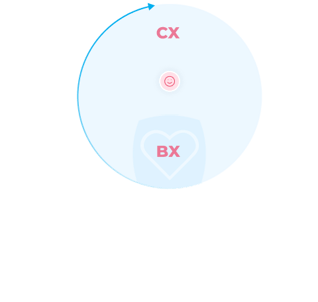
Customer experience is the feeling a customer gets when using a product or service from your company. This experience begins when the customer purchases your product or service. As such, it encompasses more than call centers and successful problem resolution. The customer experience is measured across the entire customer journey, so it also includes contact moments with sales, marketing or support.
At each of these moments, customers form a judgment about the contact they have with a company. Here they look at whether the company meets their expectations, but also whether it was easy to find and eventually buy the product. Customer experience is basically the sum of all these interactions. In many cases, a good customer experience leads to a new or repeat purchase within your company. Because, when the experience is positive, you bind customers to your brand.
3. SX | Service experience
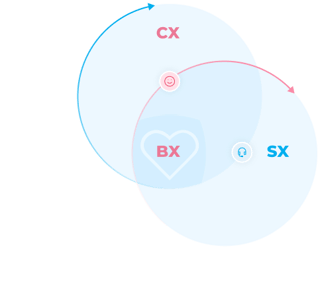
Service experience is about the experience at the moment a customer or employee contacts the organization because of a question or possible complaint. In particular, it is about the contacts involving human interaction (think of a phone call, email, WhatsApp or chat).
With a good service experience, you achieve a lot of profit as an organization. By measuring the performance of your customer service agents, you can train new and existing agents in a more targeted way. Because, through good work of service agents, lost customers can be regained. This is also where your brand is represented by the human contact between service agents and customers. All the more important, then, to value this experience.
4. UX | User Experience
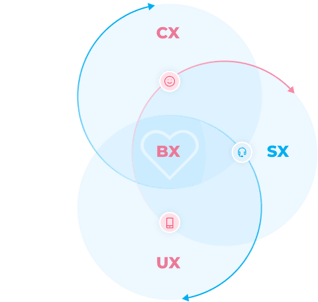
User experience is about more than just ease of use and perceived usefulness. This type of experience measures precisely whether you have created an optimal user experience. UX is focused on increasing customer satisfaction by pursuing a wow effect.
A good User Experience results in fewer frustrations among your visitors and higher customer appreciation regarding the product, website or service. This in turn creates a lot less hassle in the service department because the visitor can find everything on the website.
5. EX | Employee experience
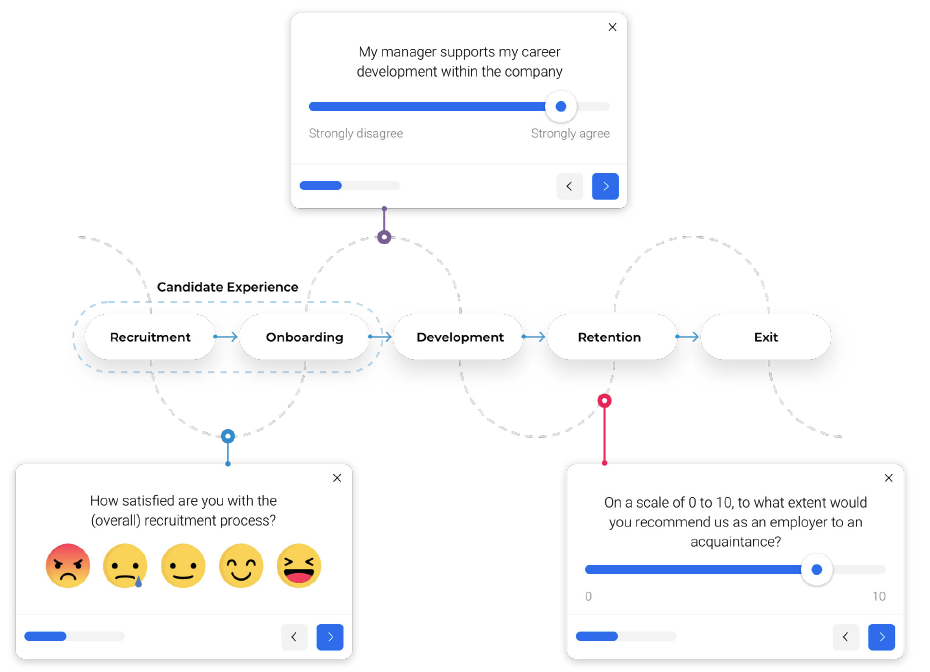
Employee experience, or employee experience is the feeling employees have about an organization. Employee experience is generally measured at different touch points. For example, consider the candidate experience. It starts at the time of application and progresses through to the offering of benefits and finally ends with the offer of an employment contract.
Another part of the employee experience is, for example, how the company culture is perceived, but also the feeling of an employee at the eventual end of employment. Thereby, various factors such as company culture, technology and the workplace also contribute to the employee experience.
A good employee experience contributes to better talent attraction and retention. Thereby, satisfied employees will prefer to provide good customer service than dissatisfied employees. You can also expect satisfied employees to tout the company culture when they leave, improving a company's reputation for (latent) job seekers.
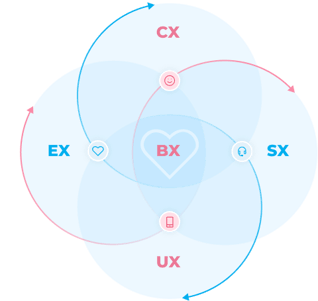
ONE CANNOT EXIST WITHOUT THE OTHER
Experience management is thus composed of the 5 most important experiences in business (BX, CX, SX, UX and EX), all of which act as moving parts to ensure customer satisfaction as well as employee satisfaction. In doing so, they are also all interrelated; one cannot exist without the other.
Companies now often use separate solutions to measure satisfaction. There is a platform to measure service, a platform to measure User Experience and yet another tool to measure customer satisfaction. Thus, data ends up in different silos, so the connection between experiences is quickly overlooked. Various departments thus work separately on their satisfaction goals, and perhaps even too many surveys are sent to customers this way.
By deploying a clear experience platform you collect all data on one platform, you can make connections, departments work more together towards the common goal (an excellent, uniform customer experience), you get better and more results and the support in customer experience within the organization becomes stronger. Experience Management (XM) combines the voice of your customers and employees with the skills to deliver extraordinary experiences. By measuring all these experiences, you'll soon see exactly where you need to focus as a company to meet the goals you've set.

THE IMPACT OF EXPERIENCES ON YOUR BOTTOM LINE
It may sound simplistic, but the main reason why experience management is essential for companies is that they want to make customers and colleagues happy. When employees are satisfied with their experience at work, they are more likely to achieve better results in their day-to-day work and, as an organization, you experience lower employee turnover. Customers and stakeholders invest more confidently in a product when they can assume the experience will be smooth and effective.
So Experience Management is only really going to impact your bottom line if you consider it as an essential element that you constantly monitor and improve. Often companies find themselves in situations where they naturally strive to do the best job possible and meet SLAs, but don't have the resources to measure whether things have actually gone well. Important data such as customer experience or employee satisfaction is then lost.
In short: anno nowadays, it is no longer enough just to deliver a good service, but rather it is important to measure all experiences and implement these results. This is how you arrive at your optimal business strategy.
The 4 benefits of measuring experience management
One advantage of an experience management platform is that it saves you considerable costs and avoids the use of multiple tooling - which means you keep losing the thread of customer feedback. But besides collecting important data and saving costs, there are also many business benefits to measuring experiences.
Whitepaper | Review fatigue
Reviews are very common for consumers to read before purchasing a product. Why do reviews work so well? Find out in this white paper!

The feedback solution for you. In action!
At Insocial, we've sent over 5 million surveys for our clients. We are experts in Customer Experience and can show you the possibilities for your organization in a short introduction. In this meeting, we'll tell you all about:
- how our software works;
- Exactly how you can apply Insocial;
- what the results and benefits are;
- how we improved the customer experience for similar organizations;
- the price: we will give you an indication based on your request.